
Road Trip Iceland: Navigate this Unique Country with Confidence
Planning a solo road trip in Iceland? Learn essential driving advice, daily safety checks, and how to navigate the Ring Road with confidence. Stay safe with weather, road, and travel resources before you go.


Iceland is one of the best countries in the world for a solo road trip. The landscapes are vast, the traffic is light and the scenery shifts from waterfalls to lava fields to glaciers in a single afternoon.
But Iceland is also unique. Weather changes fast. Roads can close suddenly. Gravel, wind and isolation are real factors especially when you’re traveling alone.
With the right preparation, driving in Iceland is not intimidating. It’s empowering.
General Driving Advice for Iceland
Driving in Iceland is straightforward but different enough that preparation matters.
1. Understand Road Types
- Route 1 (The Ring Road) circles the country and is paved for most of its length.
- F-roads are mountain roads requiring a 4x4 vehicle and are usually open only in summer.
- Many rural roads are gravel, even if they appear on major routes.
Never take an F-road unless:
- You have a proper 4x4 vehicle.
- Your rental agreement allows it.
- You are confident driving rough terrain.
2. Watch the Wind
Strong wind is one of Iceland’s biggest driving hazards. Car doors can be ripped open and damaged instantly. Always:
- Open doors carefully.
- Park facing into the wind when possible.
- Keep both hands on the wheel in exposed areas.
3. Respect Single-Lane Bridges
There are many single-lane bridges across Iceland. Slow down well in advance. The car closest to the bridge has priority — but always make eye contact and proceed cautiously.
4. Sheep Have Right of Way (Practically)
In summer, sheep roam freely. They move unpredictably and often travel in groups. Slow down immediately if you see one near the road.
5. Fuel Strategy
Gas stations can be far apart in remote areas. Never let your tank drop below half when traveling outside major towns.
Daily Checks Before You Drive Each Day
When traveling solo, small habits create safety margins. Each morning, before starting your route, check the following:
1. Road Conditions
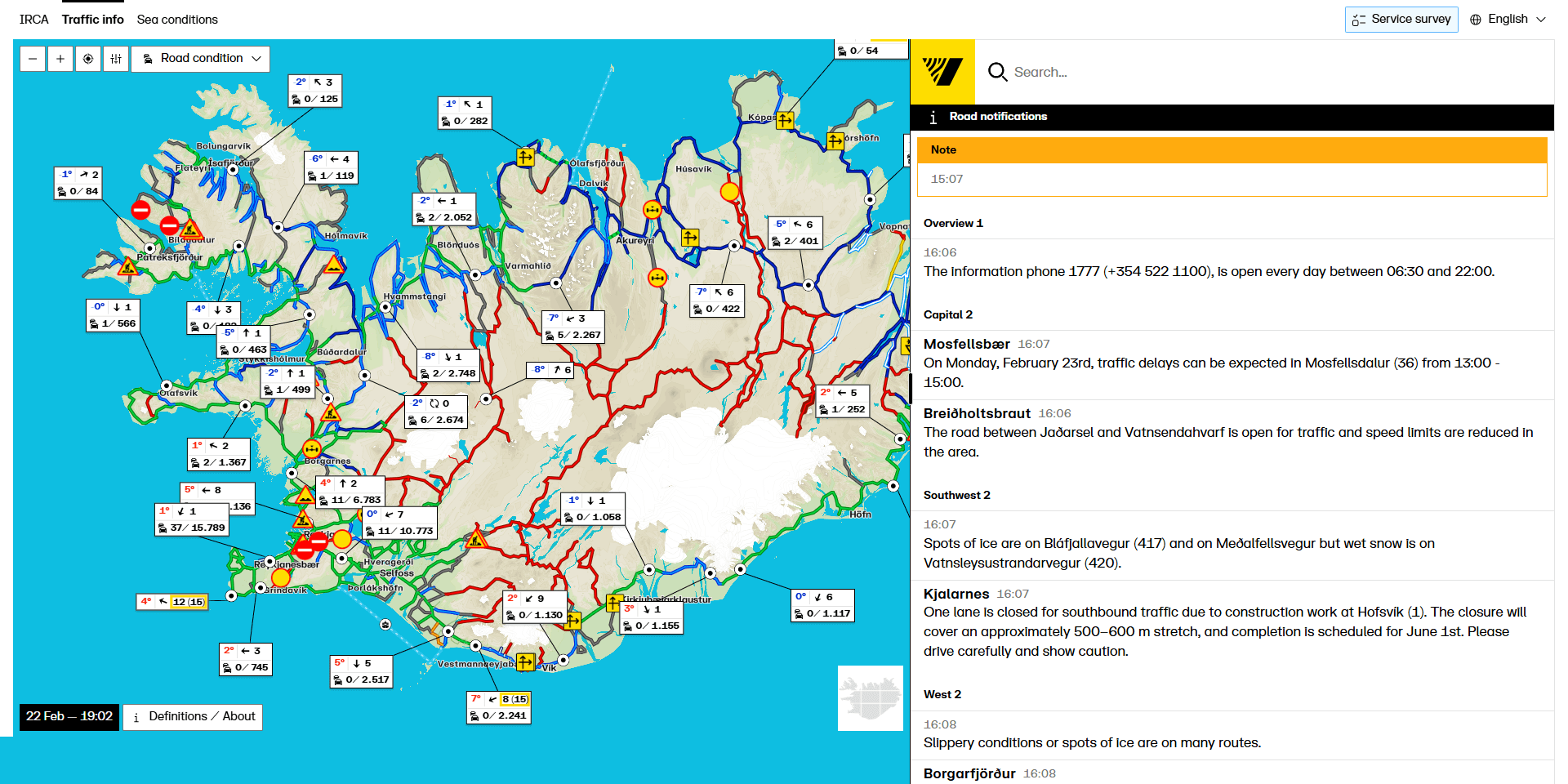
Before you drive anywhere in Iceland, check umferdin.is.
This is Iceland’s official road conditions site and one of the most important tools for a road trip. It provides real-time, color-coded updates across the entire country. Review it every morning and again midday if conditions look unstable.
Here’s what to look for:
- Road Closures: Sudden closures can happen due to storms, flooding, snow, or volcanic activity. Never assume yesterday’s open road is open today.
- Icy or Slippery Sections: Even in shoulder seasons, black ice can form overnight. In colder months, entire stretches may be marked as slippery or snow-covered.
- Wind Warnings: High winds can be more dangerous than snow. Certain exposed stretches of the Ring Road are especially vulnerable to crosswinds.
- Construction Zones: Summer is peak infrastructure season. Gravel detours, narrowed lanes and loose surfaces are common.
The site also includes:
- Live webcams along major routes so you can visually confirm conditions.
- Surface condition icons (dry, wet, snow-covered, icy, impassable).
- Mountain pass alerts, which are critical in colder months.
Conditions in Iceland can change quickly and sometimes within hours. What appears manageable in the morning can deteriorate by afternoon, especially in the highlands or along exposed coastal roads.
As a solo traveler, checking umferdin.is daily isn’t optional — it’s part of responsible planning.
2. Weather Forecast
Check vedur.is before you drive.
This is the website of the Icelandic Meteorological Office and it provides far more than a basic temperature forecast. For drivers, especially solo travelers, it is one of the most important resources available.
Look beyond the daily high and low. Pay close attention to:
- Wind Speeds (especially gusts): Sustained wind may seem manageable but gusts can be significantly stronger. Gusts over 15–20 m/s (33–45 mph) can make driving uncomfortable. Higher gusts can make certain vehicles, particularly campervans, unstable.
- Storm Alerts: Iceland uses a color-coded alert system (yellow, orange, red). Even a yellow warning can affect driving safety. Orange or red alerts may justify adjusting or postponing your route.
- Precipitation Type: Rain is common. Freezing rain or snow, even outside winter, can affect mountain passes and higher elevations.
- Volcanic Activity Updates (News Section): Iceland is geologically active. While major eruptions are rare, smaller eruptions and gas emissions can impact specific regions or cause temporary road closures.
Wind speed often matters more than temperature for drivers in Iceland. A calm 5°C (41°F) day is manageable. A windy 10°C (50°F) day can feel far more demanding, and can affect steering, door handling and vehicle stability.
Weather patterns can shift quickly, especially along the South Coast and in the highlands. Checking vedur.is in the morning — and again before long stretches of driving — gives you control over your day.
For solo travelers, that control creates confidence.
3. Safety Alerts and Travel Updates
Review Safetravel.is, managed by the Icelandic Association for Search and Rescue (ICE-SAR).
This site focuses specifically on traveler safety across Iceland’s diverse and sometimes unpredictable terrain. While umferdin.is covers road conditions and vedur.is covers meteorology, Safetravel.is connects the dots between environment, activity and real-world risk.
It includes:
- Weather Warnings in Context: Not just forecasts but practical implications — for example, which regions are affected and what types of travel may be unsafe.
- Clothing and Preparedness Guidance: Iceland’s weather can shift rapidly. The site outlines appropriate layering, footwear and equipment recommendations based on season and region.
- Hiking Alerts: Trail closures, river crossings, unstable ground conditions and seasonal hazards are clearly flagged.
- Avalanche and Crevasse Maps: Particularly important if you are near glacier areas or mountainous terrain. Even if you’re not hiking on a glacier, proximity to active zones can affect local access routes.
- Regional Advisories: Specific alerts tied to particular areas — flooding, landslides, volcanic gas dispersion, or storm impacts.
Even if your primary plan is simply to drive from town to town, Iceland’s geography is interconnected. A storm in one region can close a mountain pass that connects you to another. A hiking alert may indicate unstable conditions near a waterfall parking area. Volcanic activity may lead to temporary detours or air quality concerns.
Safetravel.is also allows you to submit travel plans for certain backcountry routes — a valuable option if you are heading into remote areas.
For solo travelers, this site reinforces a simple principle: awareness creates margin. And margin creates confidence.
4. Plan Conservative Driving Distances
Iceland’s distances look short on a map.
Reykjavík to Vík? Just a few centimeters on the screen.
Höfn to Egilsstaðir? It doesn’t appear dramatic.
But maps don’t show texture.
In Iceland:
- You will stop frequently for photos. Waterfalls appear without warning. Lava fields stretch in every direction. Glaciers emerge around a bend. Even if you plan not to stop often, you will.
- Gravel roads reduce speed. Even sections of well-traveled routes can shift from smooth pavement to loose gravel. You’ll naturally slow down and you should.
- Weather may slow you down. Wind, rain, fog, or sudden squalls can reduce visibility and comfort. You may choose to drive more cautiously and that’s the right decision.
- Single-lane bridges and sheep crossings require patience. These moments add minutes that don’t show up in GPS estimates.
- Fuel, restrooms and food stops take planning. Services are not always frequent in rural areas.
Navigation apps often calculate drive times under ideal conditions. Iceland rarely offers ideal conditions all day, every day.
A realistic solo pace, one that allows for spontaneity without stress, is 150–250 km per day.
At that pace, you can:
- Stop without rushing.
- Adjust for weather.
- Arrive before dark (especially important outside summer).
- Avoid fatigue.
The goal of a solo Iceland road trip is not efficiency. It’s presence.
Build margin into your days. Iceland rewards travelers who move deliberately.
Driving Route Iceland
The classic Iceland road trip follows Route 1 (The Ring Road). It can be completed in 7–10 days, though 10–14 days allows for a far more relaxed pace.
The Golden Circle (Day Trip from Reykjavik)

The Golden Circle is Iceland’s most accessible and structured driving route. It forms a loop east of Reykjavík and is often the first experience travelers have behind the wheel.
It includes three major stops:
- Þingvellir National Park
A UNESCO World Heritage Site and one of Iceland’s most historically significant places. This is where Iceland’s parliament was founded in 930 AD. Geologically, it sits between the North American and Eurasian tectonic plates. Parking is well organized, walking paths are clearly marked and roads are fully paved. It’s an easy, confidence-building first stop. - Geysir Geothermal Area
Home to the original “Geysir,” which gave all geysers their name. While the original Geysir erupts infrequently today, Strokkur erupts reliably every 5–10 minutes. Parking is directly adjacent to the site, paths are maintained and visibility is excellent — making it a low-stress stop for new drivers adjusting to Iceland’s conditions. - Gullfoss Waterfall
One of Iceland’s most powerful and iconic waterfalls. The approach roads are paved and well maintained. The parking lot is large and clearly marked. Walking paths allow you to experience the waterfall from multiple angles without technical terrain.
This route is an ideal introduction to Icelandic driving because:
- Roads are paved and maintained year-round.
- Signage is clear and consistent.
- Distances between stops are short.
- Services, restrooms and food options are available along the way.
- You are never far from assistance.
For solo travelers, the Golden Circle builds confidence quickly. You become familiar with Icelandic signage, parking systems, fuel stations and rural road conditions — all without committing to long or remote stretches.
It’s not just a sightseeing loop. It’s a practical orientation to how driving works in Iceland.
South Coast

The South Coast is one of the most visually dramatic stretches of the Ring Road and one of the most popular. Waterfalls, glaciers, volcanic beaches and moss-covered lava fields unfold in steady sequence.
Key stops include:
- Seljalandsfoss
A tall, narrow waterfall you can walk behind during warmer months. The parking area is directly off Route 1 and easy to access. Paths can be wet and slippery, especially in mist or rain, so sturdy footwear is essential. In winter, sections behind the falls may close due to ice. - Skógafoss
Wide, powerful and often crowned with rainbows on sunny days. The approach road is short and paved, with a large parking area. There are stairs to a viewing platform above the waterfall — manageable but exposed in windy conditions. - Reynisfjara Black Sand Beach
Famous for its basalt columns and powerful Atlantic waves. The access road is paved but this location demands caution. “Sneaker waves” can surge suddenly and unpredictably. Always observe warning signs and keep a safe distance from the water’s edge. - Vatnajökull Glacier Region
Home to Europe’s largest glacier and several accessible glacier lagoons, including Jökulsárlón. Roads remain paved and well maintained but distances between services increase as you move east. Weather can shift quickly near the glacier, with fog, rain, or wind reducing visibility.
While the roads along the South Coast are generally in good condition, this region is exposed to strong Atlantic winds. Crosswinds can be intense, especially near open plains and coastal stretches.
Expect:
- Sudden gusts near cliff edges and open fields.
- Reduced visibility in rain or sea mist.
- Quick weather changes moving inland toward glacier areas.
For solo drivers, the key is steady pacing. Start early if possible, build in time for unplanned stops and remain flexible if wind warnings increase.
The South Coast is accessible but it commands respect.
East Fjords
Less crowded and deeply scenic, the East Fjords feel quieter and more remote than the South Coast. Fishing villages sit between steep mountains and narrow inlets and the pace naturally slows.
Driving here is different from the long, open stretches of the South Coast.
Expect:
- Winding coastal roads that follow the contours of the fjords.
- Elevation changes as you move over mountain passes.
- Occasional gravel sections, especially on secondary routes.
- Limited services between towns.
The views are exceptional but they demand attention. Curves are frequent and weather can shift quickly as you climb in elevation. Fog can roll in unexpectedly along the coastline.
Because traffic is lighter, you may feel alone for stretches, which can be peaceful but also requires preparation. Keep your fuel topped up, monitor conditions and avoid rushing.
The East Fjords reward deliberate driving. This is a region where slowing down enhances both safety and experience.
North Iceland

North Iceland offers a different rhythm: broader landscapes, geothermal fields, waterfalls and larger towns such as Akureyri.
Key highlights include:
- Lake Mývatn, with its volcanic formations and geothermal activity.
- Dettifoss, one of Europe’s most powerful waterfalls.
- Akureyri, often called the “Capital of the North,” offering more services and accommodation options.
Road conditions in the north are generally good, particularly along the Ring Road. However:
- Distances between fuel stations can increase.
- Weather can be cooler and windier.
- Some waterfall access roads may include short gravel stretches.
- Winter conditions arrive earlier here than in the south.
The terrain feels more open and traffic remains manageable outside peak summer weeks. For solo travelers, North Iceland offers a strong balance of infrastructure and space — enough services to feel supported, yet enough landscape to feel expansive.
Drive steadily, check conditions daily and give yourself time to explore side roads thoughtfully.
West and Snæfellsnes Peninsula
Often described as “Iceland in miniature,” the Snæfellsnes Peninsula compresses many of the country’s defining landscapes into a manageable loop. Within a single day’s drive, you’ll encounter glaciers, lava fields, sea cliffs, black sand beaches and small fishing villages.
At the heart of the peninsula is Snæfellsjökull, a glacier-capped volcano that rises dramatically above the surrounding coastline. The roads circling the peninsula are generally paved and well maintained, though some secondary access roads to viewpoints may be gravel.
Highlights include:
- Dramatic coastal cliffs with seabird colonies (seasonal).
- Lava fields blanketed in moss, especially striking in soft light.
- Kirkjufell, one of Iceland’s most photographed mountains.
- Arnarstapi and Hellnar, small villages connected by scenic walking paths.
- Djupalonssandur, a black pebble beach with remnants of historic shipwrecks.
Driving here is less intense than some stretches of the East Fjords or South Coast but conditions can still shift quickly. The peninsula is exposed to North Atlantic weather and wind remains a factor, particularly near cliff edges and open coastal roads.
Because the region is compact, it works well for:
- A 1–2 day extension from Reykjavík.
- A final loop before returning to the capital.
- A shorter solo road trip for those not completing the full Ring Road.
Services are more frequent than in remote eastern stretches but less concentrated than in the south. As always, maintain good fuel habits and check road and weather updates before departing.
For solo travelers, Snæfellsnes offers variety without requiring long, isolated drives. It’s an excellent way to experience the diversity of Iceland’s terrain while keeping distances manageable.
When Is the Best Time to Drive in Iceland?
- Summer (June–August): Easiest driving conditions, long daylight hours.
- Shoulder Season (May & September): Fewer crowds, still manageable conditions.
- Winter: Possible but requires experience, winter tires and flexibility.
If this is your first solo Iceland trip, late June through early September provides the greatest margin of safety and flexibility.
Solo Driving Confidence in Iceland
Driving in Iceland rewards preparation.
You are rarely far from help but you are often far from crowds. That combination creates something special: independence without chaos.
Check conditions daily. Drive conservatively. Respect the landscape.
And then enjoy it.
There are few places in the world where a solo traveler can experience such raw beauty with such structural safety.


